
Imagine having a minor fire breakout in your kitchen or office, but using an incorrect fire extinguisher, which not only fails to douse the fire but aggravates it. Sounds scary? That is precisely what occurs in thousands of cases every year in India due to lack of awareness about fire extinguishers.
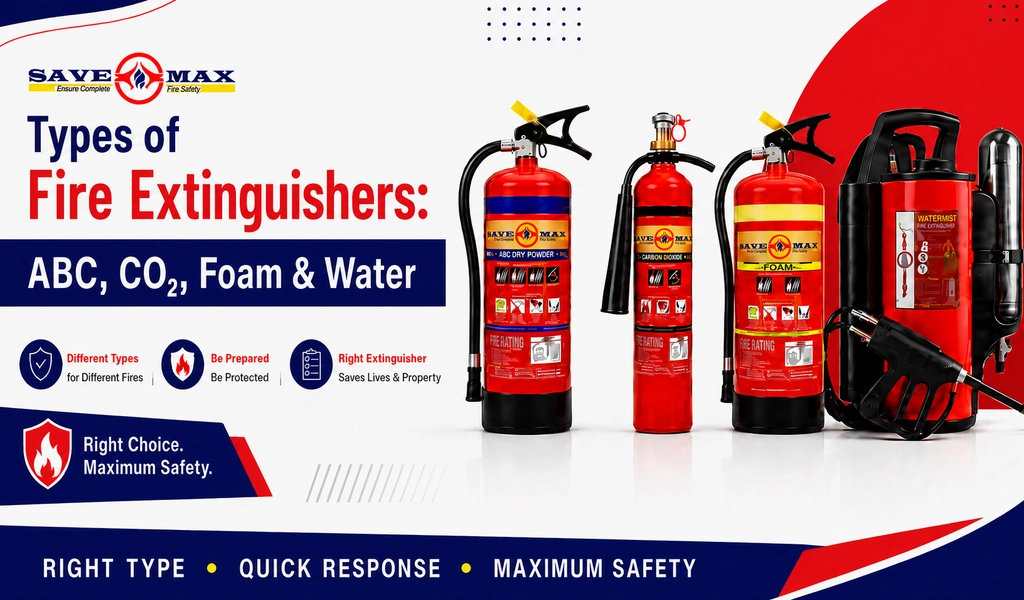
All fires aren’t the same. A fire in your kitchen that breaks out because of oil isn’t the same thing as an electric fire or a fire caused by papers. This is why there are different kinds of fire extinguishers; they all have been created to combat different types of fires. In this guide, we’ll go over the four different types of fire extinguishers — ABC, CO₂, Foam, and Water.
What Are the Main Types of Fire Extinguishers?
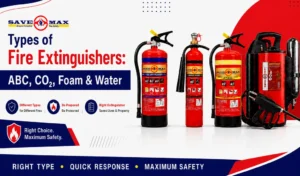
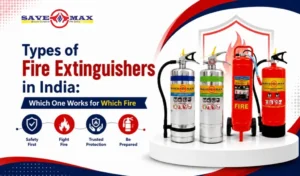
Fire extinguishers are not all the same. There are four different types of fire extinguishers – each meant to deal with certain types of fires only.
1. ABC Fire Extinguisher
ABC type of fire extinguishers is one of the most common types of fire extinguishers found in India. It uses a chemical compound, which is monoammonium phosphate, which is suitable for dealing with many types of fires.
What is an ABC Extinguisher Used For?
ABC powder extinguishers are effective for Class A, B, and C fires — covering solid combustibles, flammable liquids, and flammable gases.
Advantages
- Works on Class A, B and C fires — highly versatile
- Most affordable fire extinguisher available in India
- Easy to operate — suitable for everyone including beginners
- Widely available across all fire safety stores in India
Disadvantages
- Leaves a thick powder residue that is difficult to clean
- Can damage sensitive electronic equipment and machinery
- Reduces visibility during discharge making it hard to see
- Not suitable for cooking oil or deep fat fryer fires
Best For:
The ABC extinguisher is best for homes, offices, schools, warehouses, and factories where multiple fire risks exist. It is the most adaptable extinguisher for Indian environments where fire risks vary.
2. CO₂ Fire Extinguisher
The CO₂ fire extinguisher works by releasing carbon dioxide gas at extremely high pressure — removing oxygen from around the fire and suffocating it instantly. It is one of the cleanest types of extinguishers as it leaves no residue and requires no cleanup. This makes it perfect for sensitive environments.
Advantages of CO₂ Extinguishers
- Leaves zero residue — no cleaning required after use
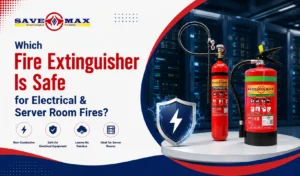
- Safe for electrical equipment, computers and servers
- Non-conductive — completely safe on live electrical fires
- Works instantly — high pressure discharge suppresses fire fast
Limitations of CO₂
- Not effective on Class A fires like wood, paper or cloth
- CO₂ can be dangerous in small enclosed spaces — reduces oxygen
- No cooling effect — fire can re-ignite after discharge
- More expensive than ABC extinguishers
Best For:
CO₂ extinguishers are best for server rooms, IT offices, electrical panels, and places with expensive electronic equipment. If your workplace has computers and electrical installations, a CO₂ extinguisher is essential.
3. Foam Fire Extinguisher
Foam fire extinguishers work by spraying a layer of aqueous foam that cools the fire and creates a blanket over the burning material — cutting off its oxygen supply completely. They are ideal for flammable liquids, diesel storage, workshops, mechanical shops, and fuel stations.
Advantages of Foam Extinguishers
- Works on both Class A and Class B fires effectively
- Foam blanket prevents fire from re-igniting after use
- Better cooling effect compared to dry powder extinguishers
- Safer to use than ABC powder in enclosed indoor spaces
- Ideal for flammable liquid fires like petrol, diesel and paint
Limitations of Foam Extinguishers
- Not safe to use on live electrical equipment or wiring
- Leaves a wet foam residue that requires cleanup afterwards
- Not suitable for burning fats or cooking oils — Class F fires
- More expensive than water extinguishers
- Not effective on Class C fires involving flammable gases
Best For:
Foam extinguishers are best for garages, petrol stations, warehouses storing flammable liquids, and industrial workshops. They offer excellent protection where both solid and liquid fire risks exist together.
4. Water Fire Extinguisher
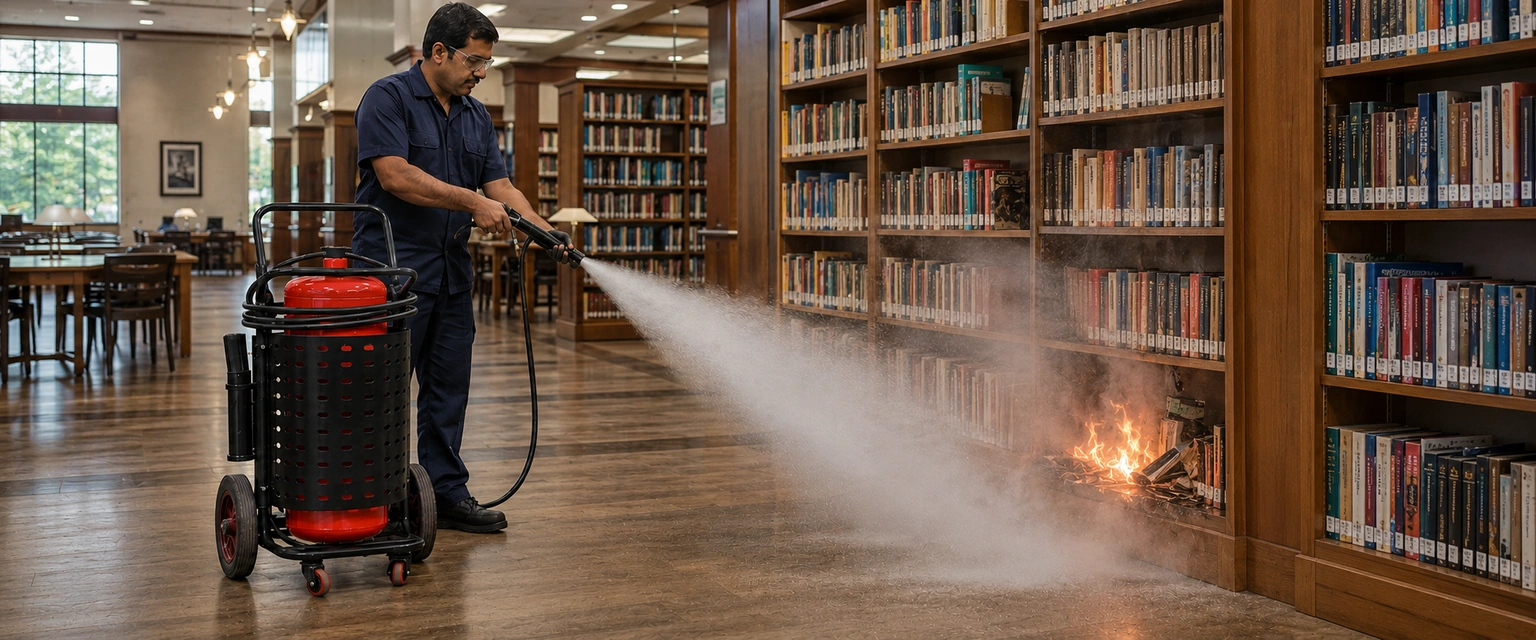
The water fire extinguisher is the simplest and oldest type of extinguisher available. It works by cooling the burning material with a powerful jet of water — removing the heat that the fire needs to survive. It is most effective on solid material fires like wood, paper, and cloth.
Advantages of Water Extinguishers
- Most affordable and easily available fire extinguisher
- Environmentally friendly — no chemicals or residue involved
- Very effective on Class A fires involving solid materials
- Easy to use and maintain — simple refilling process
- Safe to use indoors — no harmful powder or gas released
When Should You NOT Use a Water Extinguisher?
Water conducts electricity, so using a water extinguisher on electrical fires can result in electrical shocks or further spreading of fire. Never use it on oil, chemical, or electrical fires.
Best For:
Water extinguishers are best for libraries, schools, paper storage areas, and wooden furniture warehouses. They are ideal wherever Class A solid material fire risks are the primary concern.
ABC vs CO₂ vs Foam vs Water: Which Is Best?
Every extinguisher has its own strength. The best one always depends on where you are and what type of fire risk you face. Here is a simple breakdown to help you decide quickly.
-
For a Home
For a home in India, an ABC portable fire extinguisher is the smartest choice. Your home has paper, wood, cloth, LPG cylinders, and electrical appliances — all different fire risks. The ABC extinguisher covers all of them in one single unit making it the most practical option for every Indian household.
-
For an Office
An office needs two types — ABC for general areas like reception, cafeteria, and storage rooms, and CO₂ for server rooms and electrical panels. ABC fire extinguishers are the go-to choice in offices as they suit the most common fire types. Keep both for complete protection.
-
For Electrical Equipment
CO₂ is the only safe choice for electrical equipment. CO₂ is non-conductive and leaves no residue, making it safe for electronics. Using water or foam on live electrical fires can cause serious electrocution. Always keep a CO₂ extinguisher near electrical panels, server rooms, and UPS systems.
-
For Flammable Liquids
For flammable liquids like petrol, diesel, paint, and chemicals — use a Foam extinguisher. The foam blanket smothers the liquid fire and prevents re-ignition effectively. ABC powder also works on flammable liquids but foam gives better and longer lasting results for liquid fire protection.
-
For Paper, Wood and Cloth
Water mist fire extinguisher, or ABC extinguishers work best for paper, wood, and cloth fires.. Water gives superior cooling on solid material fires and is the most cost effective option. If the area also has electrical equipment nearby, use ABC instead of water to avoid any electrical shock risk during firefighting.
-
For Cooking Oil and Fat
Never use water, ABC, CO₂, or foam on a cooking oil or fat fire — it can cause a dangerous explosion. Class K fires involve cooking oils and fats like in deep-fat fryers and require a special Wet Chemical extinguisher. If you have a commercial kitchen or restaurant, a wet chemical extinguisher is absolutely essential for your safety.
How to Choose the Right Fire Extinguisher
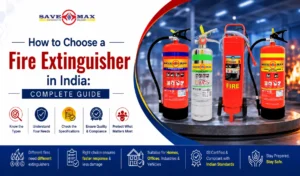
Choosing the right fire extinguisher does not have to be complicated. If you’re wondering how to choose a fire extinguisher, start by asking yourself one simple question — what kind of fire risk do I have in my space? Not sure where to start? Here are some tips to help you choose the right fire extinguisher for your space.
- Identify your fire risk first — Look around your space. Do you have electrical equipment, flammable liquids, paper and wood, or a kitchen? The type of risk decides the type of extinguisher you need.
- Match extinguisher to fire class — Every extinguisher is rated for specific fire classes. Always check the label before buying. An ABC covers Class A, B and C. CO₂ covers Class B and electrical fires. Foam covers Class A and B.
- Consider the size of your space — A small 2kg extinguisher works for a home or small office. A large commercial space or warehouse needs a 6kg or bigger unit, while a fire extinguisher trolley can make larger units easier to move during an emergency.
- Think about ease of use — Water and CO₂ extinguishers are easiest to use with minimal training. ABC powder can reduce visibility during use. Choose one that anyone in your space can operate confidently in an emergency.
- Get it serviced regularly — Buying the right extinguisher is only half the job. All extinguishers must be inspected yearly and pressure-checked every month to ensure they work when you actually need them.
Choosing the right extinguisher today can make the difference between a small incident and a major disaster tomorrow.
Common Fire Extinguisher Mistakes to Avoid
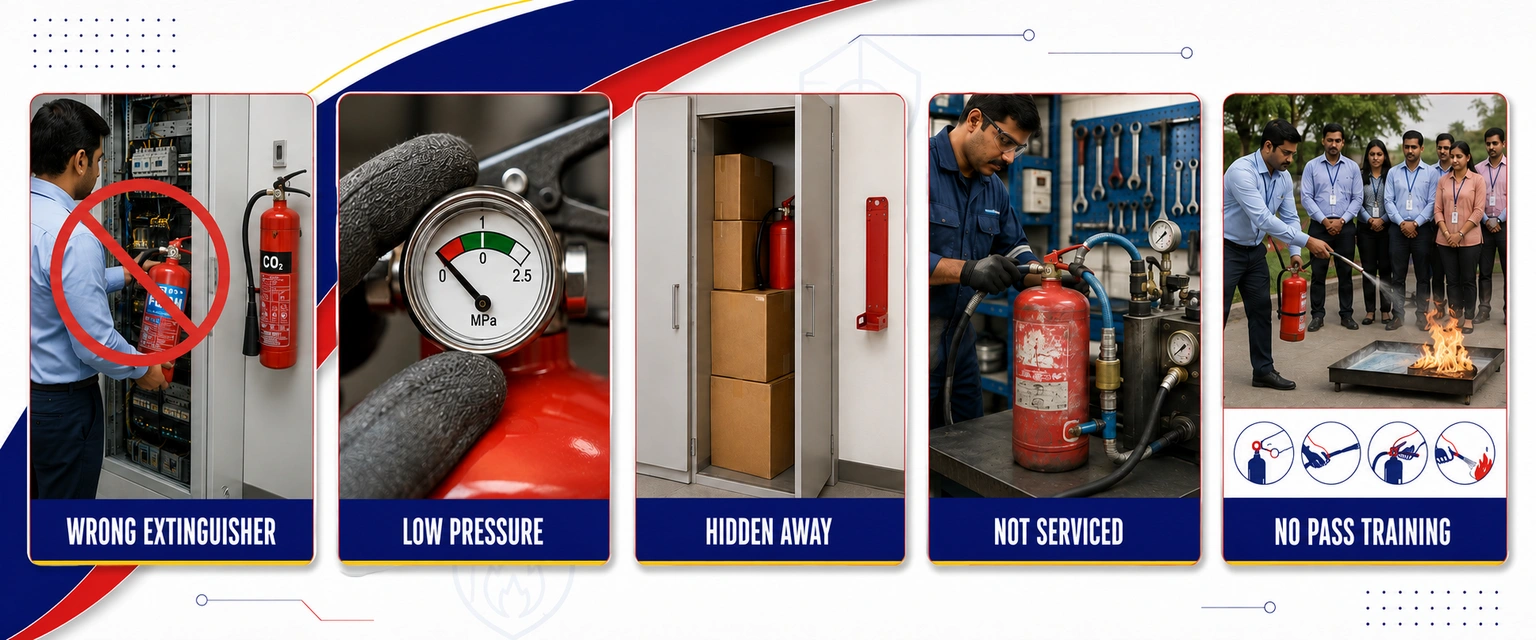
Most people only think about fire extinguishers after a fire starts. But by then, common mistakes can make everything worse in seconds. Here are some common fire extinguisher mistakes to avoid and keep your space safer.
- Using the wrong extinguisher — This is the most dangerous mistake. Using a foam extinguisher on an electrical fire can electrocute the user. Always know which extinguisher is right for which fire before an emergency happens.
- Not checking the pressure gauge regularly — An extinguisher with low pressure will not work when you need it most. Check the pressure gauge every month and get it refilled immediately if the needle is in the red zone.
- Keeping it in the wrong location — Many people store their extinguisher in a cupboard or storeroom. It should always be mounted on a wall in a clearly visible and easily accessible location — not hidden away somewhere.
- Never getting it serviced or refilled — An extinguisher that was used even partially must be refilled immediately. Many people keep a partially used extinguisher thinking it will still work fully. It will not — even a small discharge reduces its effectiveness significantly.
- Not training family or staff to use it — Buying an extinguisher is not enough. Everyone in your home or office must know how to operate it using the PASS technique — Pull, Aim, Squeeze, Sweep. Practice this once so nobody panics during a real emergency.
A fire extinguisher only protects you if it is the right type, properly maintained, and everyone knows how to use it correctly.
Final Verdict
Fire safety is not something you think about after a fire — it is something you prepare for before one ever happens. After reading this guide, you now know that choosing the right fire extinguisher is not complicated. It just requires understanding your space, your fire risks, and matching the right extinguisher to both.
For most Indian homes, an ABC extinguisher is the smartest single investment you can make today. For offices and commercial spaces, a combination of ABC and CO₂ gives complete protection. For kitchens, workshops, and fuel storage areas — Foam and Wet Chemical are non-negotiable. Do not wait for an emergency to find out you had the wrong extinguisher. Get the right one today, keep it maintained, and make sure everyone around you knows how to use it. Your safety — and the safety of everyone around you — depends on it.