
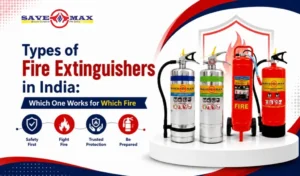
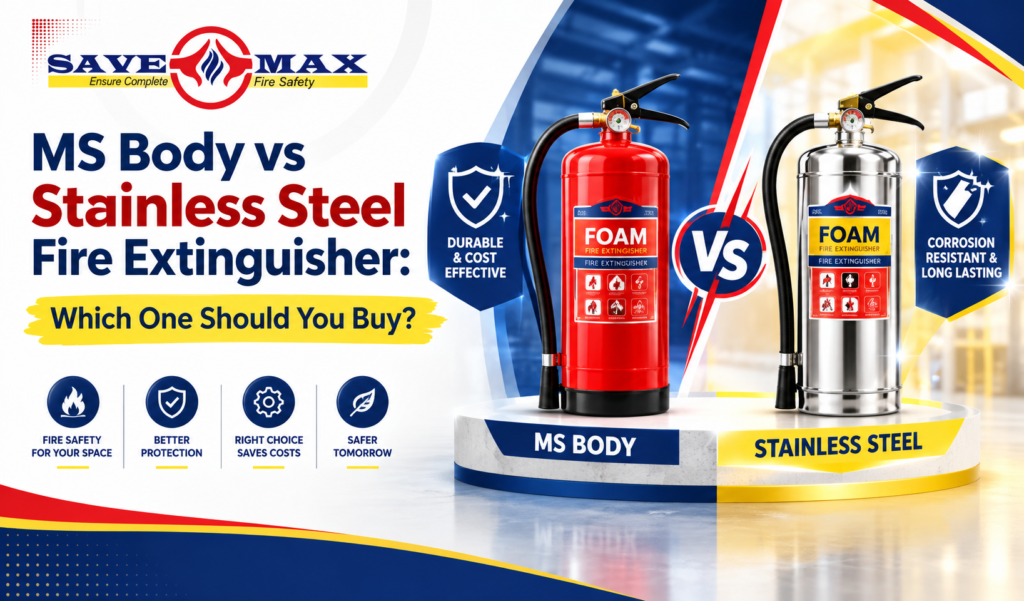
Walk into most fire safety showrooms in India, and you’ll be shown a red, powder-coated MS (mild steel) extinguisher as the default option. The stainless steel version usually sits a shelf away, priced noticeably higher, with the salesperson rarely explaining why the gap exists – just that it “looks premium.”
That’s the wrong way to make this decision. The real question isn’t which one looks better in a hotel lobby. It’s which one survives your specific environment long enough actually to work when you need it.
The honest answer is that both are compliant, both extinguish fire equally well when the extinguishing agent inside them is the same, and both are manufactured to the same IS 2190 framework in India. What changes is how each body holds up over years of exposure – and that difference matters far more in some settings than others.
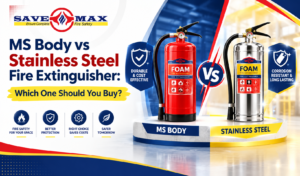
MS Body vs Stainless Steel Fire Extinguisher: What’s the Core Material Difference?
Mild steel is essentially iron alloyed with a small amount of carbon. It’s affordable, easy to weld, and structurally strong – which is exactly why it’s the default cylinder material across the fire safety industry. But mild steel has no natural resistance to rust; the moment its protective paint or powder coating is scratched, chipped, or worn through, the exposed metal begins oxidizing.
Stainless steel solves that problem at the material level rather than the coating level. It’s alloyed with chromium, which reacts with oxygen to form a thin, self-healing oxide layer on the surface. As this steel comparison guide from KDM Fabrication explains, this chromium oxide film is what actively protects stainless steel from corrosion – something mild steel simply cannot do on its own without an external coating. That’s the whole difference in one sentence: MS relies on paint to stay rust-free, SS relies on its own chemistry.
How Does Corrosion Resistance Compare Between MS and Stainless Steel Extinguishers?
This is where the two materials genuinely diverge, and it’s not a marginal difference. According to a detailed materials breakdown by Jude Steel, mild steel has almost no natural rust resistance and oxidizes quickly when exposed to moisture, rainwater, or salt-laden air – which is why it depends on galvanizing or epoxy coating, and even then typically needs re-coating or rust removal every 2 to 5 years in outdoor, coastal, or chemical environments. Stainless steel’s passive chromium layer, by contrast, largely removes that recurring maintenance burden.
This is precisely why certain industries have standardised on stainless steel fire extinguisher bodies specifically. As 119 Fire Control notes in its review of stainless steel extinguishers, pharmaceutical, healthcare, and food processing facilities favour stainless steel units for their hygienic, non-reactive surface and resistance to chipping or contamination, while marine and coastal operations rely on them to withstand the constant salt-air exposure that would otherwise corrode a standard cylinder.
If your building sits within a few kilometres of a coastline, near a chemical processing unit, or inside a facility with high ambient humidity (textile dyeing units, tanneries, cold storage), this single factor should weigh heavily in your decision.
Which Fire Extinguisher Body Lasts Longer: MS or Stainless Steel?
Independent of fire-safety-specific data, general material science comparisons are consistent on this point. Industry data compiled by LangHe Industry shows that in outdoor and exposed conditions, mild steel components typically need replacement within 5 to 10 years, while stainless steel components can remain in service for 20 to 50 years depending on grade and environment – with a lifecycle cost that ends up 30 to 50 per cent lower over time despite the higher upfront price.
It’s worth being precise about what this means for an Indian buyer, though: in India, every extinguisher – MS or SS – is still governed by the same IS 2190:2010 compliance clock, not by “how long the metal lasts” in the abstract. Where the material genuinely shows up is in whether a cylinder passes its scheduled checks. A well-maintained MS cylinder can absolutely complete its full compliance life.
But an MS body that’s picked up surface corrosion – from a humid storeroom, a coastal site, or simply years of handling – is far more likely to fail a hydrostatic test or get flagged during annual inspection than a stainless steel body exposed to the same conditions, because the corrosion attacks the structural wall thickness itself, not just the paint.
How Much More Does a Stainless Steel Fire Extinguisher Cost Than an MS Body?
Be prepared for a real price jump, not a token one. The same LangHe Industry comparison notes that stainless steel is often 3 to 5 times more expensive than mild steel as a raw material, and that difference carries through directly to the finished extinguisher. For a business buying a handful of units for a small office, this can meaningfully change the budget.
For a business buying in bulk for a coastal warehouse or a food processing plant, it’s usually justified by the maintenance and replacement costs it avoids over the following decade.
This is the trade-off in plain terms: MS costs less today and needs more attention over its life. SS costs more today and largely removes that attention as a recurring line item – but only in environments where corrosion was actually going to be a problem in the first place. If your office is a climate-controlled, indoor space in a non-industrial area, that avoided maintenance cost may never materialise, which is exactly why MS remains the default for most standard commercial and residential settings.
Which Environments Require a Stainless Steel Fire Extinguisher Body?
Based on how the material actually performs, stainless steel earns its higher price in a specific set of conditions:
- Coastal and marine-adjacent properties – salt-laden air is one of the fastest corrosion accelerators for untreated or damaged mild steel.
- Food processing, pharmaceutical, and healthcare facilities – where a rust-free, easily sanitized surface is often a compliance requirement, not a preference.
- Chemical plants and industrial units with acidic or caustic fumes – environments that degrade painted MS surfaces faster than normal indoor use.
- High-humidity storage areas – cold storage, tanneries, dyeing units, and similar spaces where condensation is a constant factor.
- High-visibility premium spaces – five-star hotels, luxury retail, and corporate lobbies sometimes choose SS purely for its finished appearance, which is a legitimate but separate reason from corrosion protection.
Where Does an MS Body Fire Extinguisher Make More Sense?
For the vast majority of installations – standard offices, retail shops, schools, residential flats, warehouses in non-coastal regions – a properly powder-coated MS extinguisher, inspected on schedule, does the job reliably and at a fraction of the cost. There’s no fire-safety performance gap between the two; a 4 Kg ABC MS unit and a 4 Kg ABC SS unit extinguish the same fire the same way, because the extinguishing mechanism has nothing to do with the shell material. The only real question is longevity under environmental stress – and if that stress isn’t present, you’re paying a premium for a benefit you won’t need.
MS vs Stainless Steel Fire Extinguisher: Which One Meets IS 2190 Compliance?
Both are fully compliant. IS 2190:2010, the Indian Standard governing selection, installation, and maintenance of portable fire extinguishers, doesn’t mandate one body material over the other – it sets performance and testing requirements that apply regardless of shell material.
What it does specify is the maintenance discipline both types must follow: a monthly visual check, a detailed annual inspection, and periodic hydrostatic testing (broadly every 3 years for water, foam, and dry chemical stored-pressure types, and every 5 years for CO2 and clean agent cylinders), alongside a defined maximum service life from the date of manufacture.
A stainless steel body doesn’t exempt you from this schedule – it simply makes it more likely the cylinder sails through each check without corrosion-related findings.
MS Body vs Stainless Steel Fire Extinguisher: Quick Comparison Table
| Factor | MS (Mild Steel) Body | Stainless Steel Body |
| Corrosion resistance | Relies on paint/powder coating; vulnerable once scratched | Naturally corrosion-resistant via chromium oxide layer |
| Upfront cost | Lower – the industry default | Typically 3–5x higher raw material cost |
| Best suited for | Standard offices, homes, shops, schools, indoor warehouses | Coastal sites, marine use, pharma, food processing, high-humidity zones |
| Maintenance needs | Periodic recoating/touch-up in harsh conditions | Minimal – passive layer largely self-maintains |
| IS 2190 compliance | Fully compliant | Fully compliant |
| Appearance over time | Can show wear, chipping, surface rust | Retains a clean, premium finish for longer |
| Ideal buyer | Cost-conscious, standard-risk premises | Corrosive-environment or hygiene-sensitive premises |
How to Choose Between MS and Stainless Steel Fire Extinguishers for Your Property
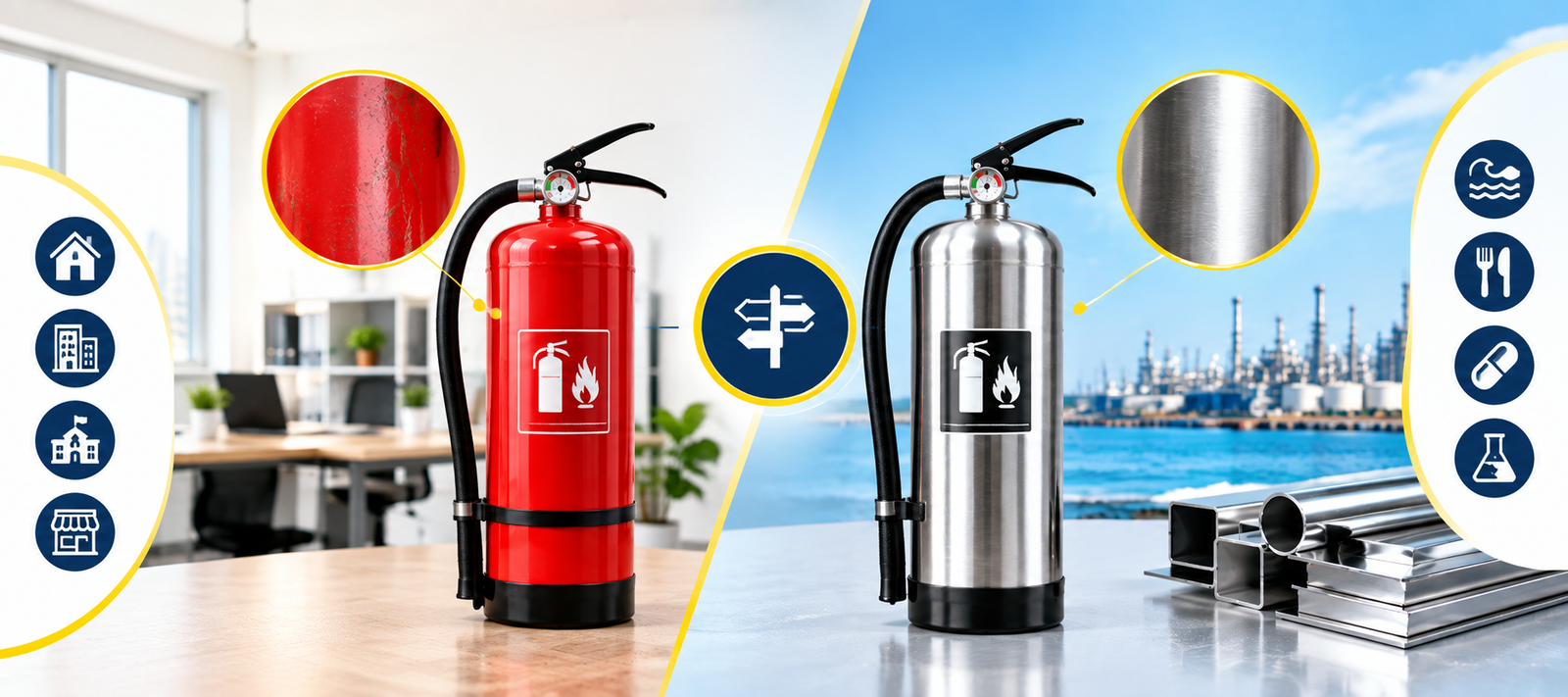
The decision comes down to one honest question: does your environment actively corrode metal? If you’re in a standard office, home, school, or retail space away from the coast or heavy industry, an MS body extinguisher – properly maintained on the IS 2190 inspection and testing schedule – is the sensible, cost-effective choice, and it’s exactly why it remains the industry standard. If you’re near the coast, running a food or pharma facility, or operating in a humid or chemically aggressive environment, stainless steel earns its higher price by removing corrosion as a recurring risk over the extinguisher’s working life.
If you’re still weighing capacity alongside body type, it’s worth reading how to calculate the right Kg for your office & shop first, since the two decisions – capacity & body material – are usually made together during a project order. Once you’ve settled on both, you can explore MS & SS body options across our portable extinguisher range and get a recommendation based on your site conditions rather than guesswork.