
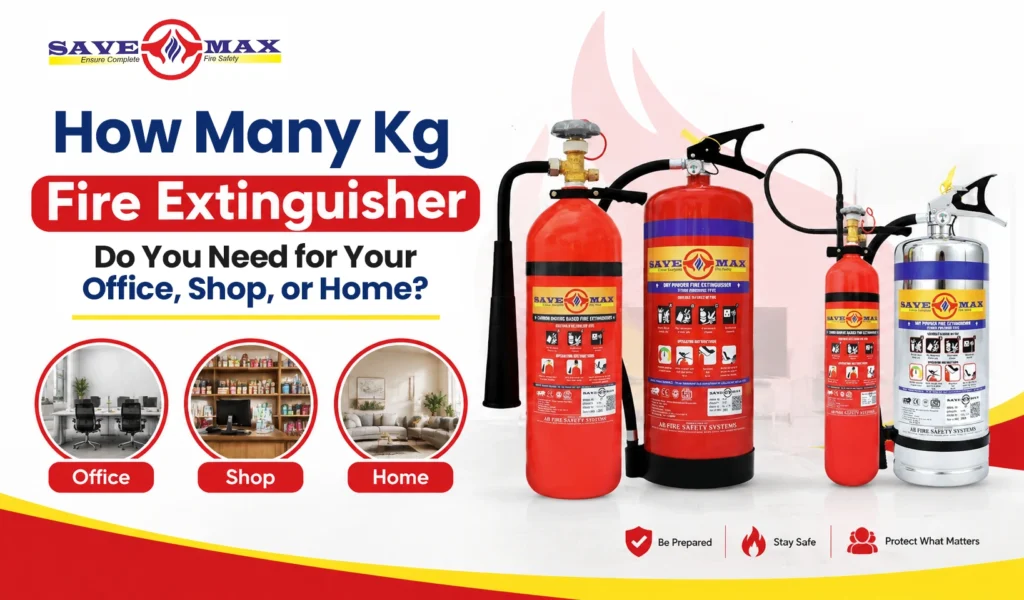
Most people buy a fire extinguisher the same way they buy a fire extinguisher cover: they walk into a shop, ask for “the standard one,” and leave with a 4 Kg ABC unit because that’s what the salesperson had in stock. Nobody checks whether 4 Kg actually covers their floor area.
Nobody asks how far that extinguisher is from the farthest desk, the farthest shelf, or the farthest bedroom. It just gets mounted near the entrance and forgotten about — until an inspection, an insurance audit, or worse, an actual fire, exposes the gap.
The right capacity isn’t a guess and it isn’t one-size-fits-all. It comes down to three things: how much floor area you’re covering, what’s actually stored or used in that space, and how far anyone would have to run to grab an extinguisher in an emergency. Get those three right, and the “how many Kg” question answers itself.
Fire Extinguisher Capacity Chart: Quick Answer for Offices, Shops & Homes
If you just need a starting point before the details, here’s the general reference most fire safety consultants in India work from, based on the National Building Code (NBC) and IS 2190 guidelines for portable fire extinguisher distribution:
| Space Type | Typical Floor Area | Recommended Capacity | Approx. Units Needed |
| Small office / studio | Up to 150 sq. ft. | 2 Kg ABC | 1 |
| Standard office | 150–1,000 sq. ft. | 4 Kg ABC | 1 per 150–200 sq. ft. |
| Retail shop | 300–600 sq. ft. | 4 Kg or 6 Kg ABC | 2 (entrance + rear) |
| Large office floor / co-working space | 1,000–3,000 sq. ft. | 4 Kg or 6 Kg ABC | 1 per 150–200 sq. ft., positioned near exits |
| Home/apartment | Any size | 2 Kg ABC (kitchen-adjacent) | 1 per flat |
| Warehouse/godown | 3,000+ sq. ft. | 9 Kg ABC or 9 Lt Water/Foam | Based on travel distance, not just area |
| Commercial kitchen | Any size | 2–4 Lt Kitchen Fire (Class F) | 1 near cooking line, 1 near exit |
Treat this table as a starting point, not a final answer — the sections below explain why your actual number might be different.
How to Calculate the Right Fire Extinguisher Size: Area, Hazard Class & Travel Distance
Fire safety consultants don’t just measure square footage and stop there. Three variables decide your final count and capacity:
1. Floor area: NBC guidance generally works out to one extinguisher per 150–200 sq. ft. of covered area for standard office and commercial risk. This is the number most people stop at — but it’s only the first filter.
2. Hazard classification: A carpeted office and a paint storage room are not the same risk, even if they’re the exact same size. IS 2190 splits occupancies into light, ordinary, and high hazard categories, and higher-hazard areas need more extinguishers per square foot, not fewer. A server room, electrical panel area, or commercial kitchen counts as higher-risk regardless of its floor area, and typically needs a dedicated unit on top of whatever the area calculation gives you.
3. Travel distance: This is the rule most small business owners have never heard of, and it’s the one that actually decides placement, not just quantity. The standard used across Indian fire codes caps the distance anyone should have to walk to reach an extinguisher at roughly 15 metres for ordinary hazard occupancies, tighter for higher-risk zones.
If your area calculation says you need 2 extinguishers, but placing them evenly still leaves a back corner more than 15 metres from the nearest one, you need a 3rd — not because the math says so, but because the walk does.
This is why a single 9 Kg extinguisher sitting at the front door of a 2,000 sq. ft. office “technically” meets a rough area calculation but fails a real audit. Coverage isn’t about having enough total Kg in the building — it’s about having a reachable extinguisher within a short walk of every point in that building.
How Many Kg Fire Extinguisher Does a Standard Office Need? (Worked Example)
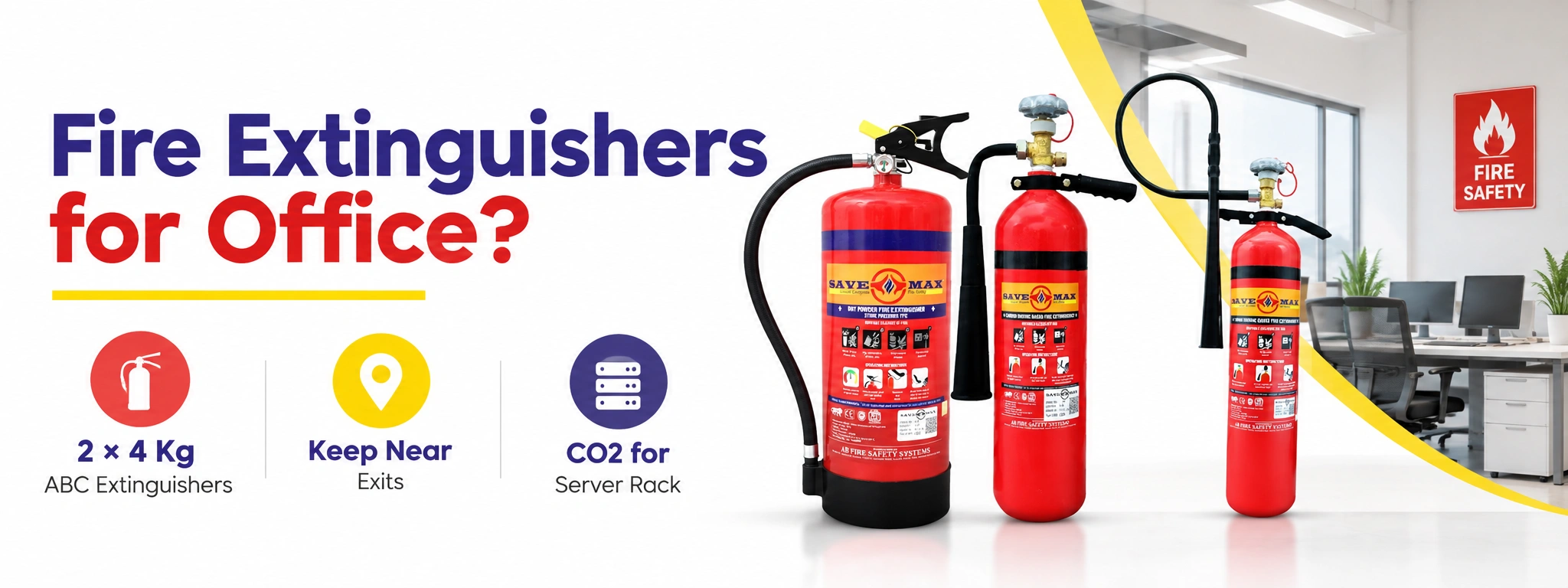
Say you run a 1,200 sq. ft. office with an open floor plan, a small pantry, and a server rack in one corner.
- Area calculation: 1,200 ÷ 175 (midpoint of the 150–200 sq. ft. rule) ≈ 7 units worth of coverage, but this gets consolidated into fewer, well-placed extinguishers rather than 7 tiny ones.
- Practical translation: two 4 Kg ABC extinguishers, positioned so no desk is more than a short walk from one, near the two exits rather than clustered together.
- The server rack corner needs its own dedicated CO2 or Clean Agent extinguisher, separate from the ABC count, because dry powder residue on electronics defeats the purpose of having the equipment in the first place.
That’s the difference between “checking a box” and actually planning for the space.
How Many Fire Extinguishers Does a Retail Shop Need? (Worked Example)
A 400 sq. ft. clothing or electronics shop with a small storeroom at the back is a common setup across Indian markets, and it’s also one of the most common places to see just one undersized extinguisher tucked behind the billing counter.
- One unit near the entrance is standard, but it’s rarely enough on its own — if a fire starts near the storeroom, that front-counter extinguisher might be the one thing nobody can reach.
- A second unit near the storeroom or rear exit closes that gap.
- For shops selling flammable stock (paints, cosmetics with aerosol propellants, electronics with lithium batteries), a 4 Kg or 6 Kg ABC unit is a safer baseline than the smaller 2 Kg often sold as a “starter” size.
NBC guidance for a standard retail shop generally points to at least two extinguishers in the 4–6 Kg range — not one, even if the total floor area seems small enough to justify just one on paper.
How Many Kg Fire Extinguisher Do You Need for a Home or Apartment?
Residential fire safety gets far less attention than commercial, but the guidance is simpler here: NBC recommends that every individual flat, not just every building or every floor, should ideally have at least one portable extinguisher. For high-rise apartments in particular, having an extinguisher only in the common corridor or lobby doesn’t help someone inside a locked flat during a kitchen fire.
For a typical home:
- A 2 Kg ABC extinguisher mounted near the kitchen (but not directly above the stove) covers general cooking and electrical risk.
- Households with a modular kitchen or heavy LPG/gas usage sometimes add a small water-based or foam unit as a secondary option for non-electrical fires.
- Housing societies managing multiple towers should treat each flat’s coverage separately from the building’s common-area extinguishers — one doesn’t substitute for the other.
Which Areas Need a Dedicated Fire Extinguisher Regardless of Floor Area?
This is the exception that trips up almost every area-based calculation: certain zones need a dedicated extinguisher no matter how small they are or how well the rest of the building is covered.
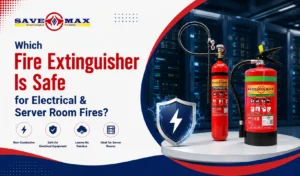
- Server rooms and electrical panels — need CO2 or Clean Agent units specifically, since ABC powder residue and water-based agents can damage equipment or create a shock hazard. (We’ve covered this in more depth in our guide on choosing the right extinguisher for electrical and server room fires.)
- Commercial kitchens — need a Class F kitchen fire extinguisher near the cooking line itself, in addition to whatever covers the rest of the restaurant.
- Fuel storage, paint rooms, chemical storage — need foam or CO2 units positioned for Class B risk, independent of the building’s general ABC coverage.
If your facility has any of these zones, budget for them as separate line items, not as part of your general area-based count.
Common Fire Extinguisher Capacity Mistakes That Leave You Under-Protected
- Buying one large extinguisher instead of two smaller ones: A single 9 Kg unit sounds like more protection than two 4 Kg units, but if it sits in one corner, it does nothing for someone standing 30 metres away when a fire starts. Distribution beats total weight.
- Ignoring travel distance: Area-per-extinguisher math is a floor, not a placement plan. Always check the actual walking distance from the farthest point in the room.
- Treating high-risk zones as part of general coverage: A CO2 unit near the server rack doesn’t “count” toward your office’s general ABC requirement, and an ABC unit near the server rack shouldn’t be there at all.
- Skipping the annual top-up: Even the right capacity, correctly placed, loses effectiveness if it isn’t inspected every six months and refilled annually as per IS 2171 requirements — a fully-rated extinguisher that’s overdue for service is functionally the wrong size, because it may not discharge at full capacity.
Fire Extinguisher Capacity Cheat Sheet: Matching Kg to Your Space Size
| If your space is… | Go with… |
| A single room or cabin under 150 sq. ft. | 1× 2 Kg ABC |
| A standard office (150–1,000 sq. ft.) | 4 Kg ABC, 1 per 150–200 sq. ft. |
| A retail shop with a storeroom | 2× 4–6 Kg ABC (front + rear) |
| A home or apartment | 1× 2 Kg ABC near the kitchen |
| A warehouse or godown | 9 Kg ABC or 9 Lt Water/Foam, based on travel distance |
| A server room or electrical panel | Dedicated 2–4.5 Kg CO2 or Clean Agent unit |
| A commercial kitchen | 2–4 Lt Kitchen Fire (Class F) unit near the cooking line |
If you’re planning for a project rather than a single site — a multi-floor office, a chain of retail outlets, or a residential society — it’s worth getting an on-site fire safety assessment rather than extrapolating this table across every location, since occupancy type and local fire department requirements can shift the numbers.
How to Get the Right Fire Extinguisher Capacity for Your Property
Working out capacity on your own gets you close, but the fastest way to get it exactly right — especially for offices, retail chains, warehouses, or residential societies — is a quick site assessment from a manufacturer who can map hazard zones, travel distances, and compliance requirements in one visit. Savemax’s team does exactly this as part of every project enquiry, and you can check our full range of 1 Kg to 9 Kg portable fire extinguishers to see which capacities and body types fit your space before you request a consultation.