
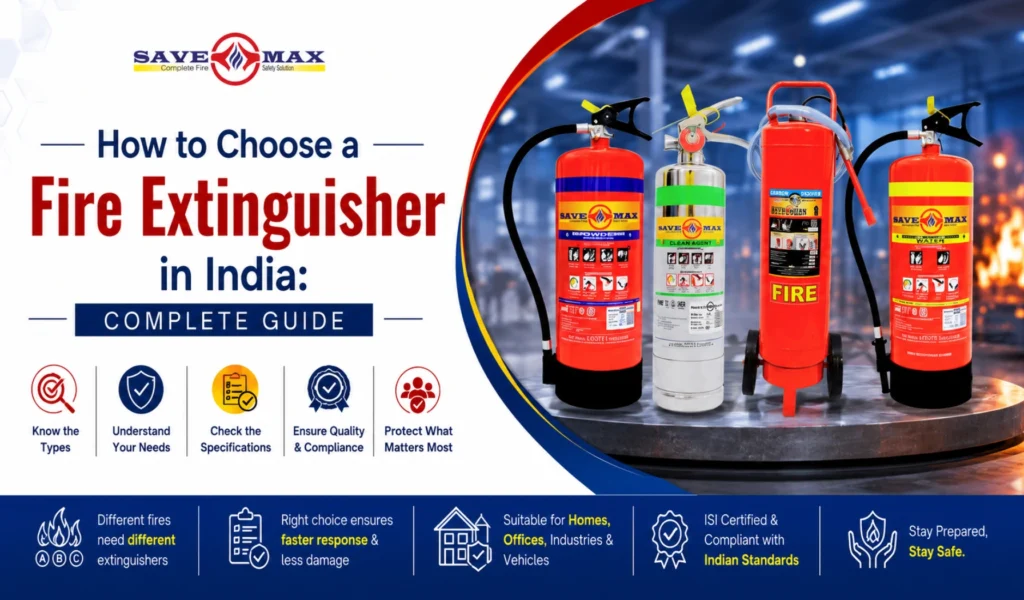
India recorded nearly 6,000 fire accidents and 5,888 deaths in 2024 alone – that is 16 people every day, according to the National Crime Records Bureau. What makes these numbers harder to read is that most of these fires started small. A portable fire extinguisher – used correctly and at the right moment – can stop a small fire before it becomes a tragedy.
But here is the problem. Walk into any office, school, or factory in India and you will likely find one type of fire extinguisher mounted on every floor – regardless of what fire risks are actually present. That is not fire safety. That is a compliance checkbox.
This guide helps you understand which fire extinguisher is actually right for your building, your floor, and your risk – in plain language, without the technical overload.
What Types of Fires Can Happen in Your Building?
Before you buy any fire extinguisher, you need to know what kind of fire you are actually protecting against. Fires are grouped into classes based on what is burning. Using the wrong extinguisher on the wrong fire class does not just fail – it can make the fire worse.
Here are the six fire classes used in India:
| Fire Class | What Is Burning | Where It Usually Happens |
|---|---|---|
| Class A | Wood, paper, fabric, plastic | Offices, schools, homes, warehouses |
| Class B | Petrol, diesel, paint, solvents | Petrol pumps, garages, paint stores |
| Class C | LPG, cooking gas, CNG | Gas storage areas, kitchens, welding zones |
| Class D | Metal powders like magnesium | Foundries, metal fabrication units |
| Class E | Live electrical equipment | Server rooms, electrical panels, offices |
| Class F | Cooking oil and fats | Restaurant kitchens, hotel kitchens, canteens |
Two mistakes that cause serious injuries every year in India:
- Spraying water on an electrical fire – water conducts electricity and causes electrocution
- Spraying water on a burning cooking oil fire – water turns to steam instantly, causing boiling oil to explode outward
Knowing your fire class is the first step. Everything else follows from here.
Types of Fire Extinguishers in India – and Which One Does What
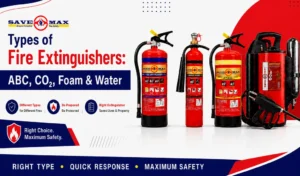
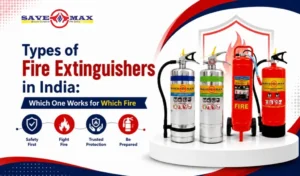
There are six main types of fire extinguishers available in India. Each one is designed for specific fire risks. Here is what each one does and where it belongs:
ABC Dry Powder Fire Extinguisher
This is the most common fire extinguisher you will see across India – in offices, shops, schools, and factories. It works on Class A, B, C, and E fires, which makes it a good general-purpose choice for most buildings.
It is available in sizes from 1 Kg to 9 Kg for portable use, and up to 75 Kg for large industrial trolley-mounted extinguisher units.
One important limitation: After use, it leaves a fine powder that is hard to clean and can damage computers and electronic equipment. If you have a server room or data centre, this is not the right choice for that space – even if it works everywhere else in the building.
CO2 Fire Extinguisher
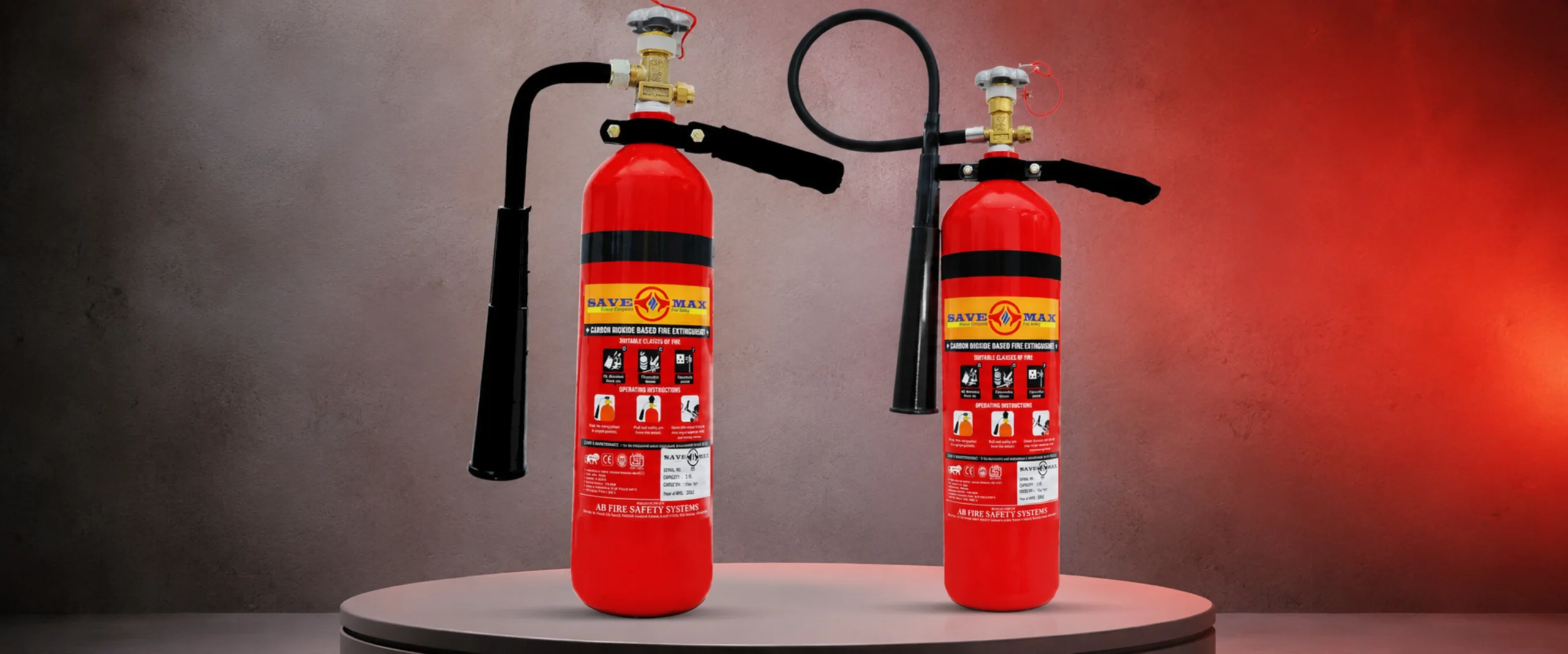
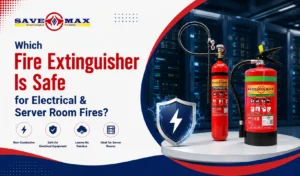
CO2 extinguishers are the go-to choice for electrical fires. They discharge carbon dioxide gas, which cuts off the oxygen supply to the fire and leaves absolutely no residue – which means your server, laptop, or electrical panel is not damaged in the process.
Available in 2 Kg, 3 Kg, and 4.5 Kg for portable use, and in larger trolley sizes for industrial electrical areas.
Where it belongs: Server rooms, data centres, electrical control panels, UPS rooms, and bank equipment rooms.
One thing to be careful about: In a very small, enclosed room, a CO2 extinguisher displaces the oxygen in the room itself – not just around the fire. Use it quickly and leave the room after discharge.
Clean Agent Fire Extinguisher
Think of a clean agent extinguisher as a CO2 extinguisher that is also safe for people in the room. It uses a special gas that suppresses fire without displacing room oxygen and leaves no residue at all.
It is the preferred option for hospitals, museums, pharmaceutical labs, and any occupied space where sensitive equipment needs protection.
It costs more than CO2 – but in environments where you cannot risk harm to patients, archives, or precision equipment, it is the right investment.
Water Fire Extinguisher
Water extinguishers are simple – they cool the burning material by spraying pressurised water. They work on Class A fires (wood, paper, fabric) and nothing else.
Do not use water extinguishers near electrical equipment, flammable liquids, or cooking oils. The applications are limited, but water is the best and cleanest option for spaces like libraries, paper storage areas, and woodworks.
Foam Fire Extinguisher
Foam extinguishers spray an AFFF (Aqueous Film Forming Foam) solution that forms a blanket over burning liquids, cutting off the air supply and stopping the fire from re-igniting.
They work on Class A and Class B fires – making them a good choice for petrol pumps, fuel depots, paint stores, and garages.
Available in 9-litre portable units and larger trolley-mounted units from 25 to 45 litres for industrial use.
Kitchen Fire Extinguisher (Wet Chemical)
This is the only extinguisher specifically made for cooking oil fires. When hot cooking oil catches fire, spraying water or powder on it causes a violent reaction – the oil explodes outward, spreading fire and causing serious burns.
A kitchen fire extinguisher uses a wet chemical solution that cools the oil quickly and forms a protective layer over it, stopping it from catching fire again.
If you run a restaurant, hotel kitchen, canteen, or cloud kitchen – this extinguisher is mandatory. No other type can safely replace it for a cooking oil fire.
Available in 2-litre, 4-litre, and 6-litre sizes.
Which Fire Extinguisher Works on Which Fire?
| Extinguisher Type | Class A | Class B | Class C | Class E | Class F |
|---|---|---|---|---|---|
| ABC Dry Powder | ✅ | ✅ | ✅ | ✅ | ❌ |
| CO₂ | ❌ | ✅ | ❌ | ✅ | ❌ |
| Clean Agent | ✅ | ✅ | ❌ | ✅ | ❌ |
| Water | ✅ | ❌ | ❌ | ❌ | ❌ |
| Foam | ✅ | ✅ | ❌ | ❌ | ❌ |
| Kitchen (Wet Chemical) | ✅ | ❌ | ❌ | ❌ | ✅ |
Which Fire Extinguisher Does Your Building Need?
Most buildings have more than one type of fire risk – which means they usually need more than one type of extinguisher. Here is a simple breakdown by building type:
Office Building
An office has Class A risk (paper, furniture) everywhere, Class E risk (electrical panels, servers), and often a small kitchen or pantry.
- Office floors: 4 Kg ABC Dry Powder
- Server room or IT room: 4.5 Kg CO2 or Clean Agent
- Electrical panel: 2 Kg CO2
- Pantry or canteen: 2-litre Kitchen Fire Extinguisher
Hospital or Healthcare Facility
Hospitals need extra care – ABC powder is a health risk in patient areas because the fine powder can be inhaled.
- Patient wards and ICUs: Clean Agent extinguisher
- Medical equipment rooms: Clean Agent
- Kitchen: 4-litre Kitchen Fire Extinguisher
- Electrical room: 4.5 Kg CO2
School or College
- Classrooms and corridors: 4 Kg ABC Dry Powder
- Science or chemistry lab: 2 Kg CO2 alongside a 4 Kg ABC
- Canteen: 2 to 4-litre Kitchen Fire Extinguisher
- Electrical room: 2 Kg CO2
Warehouse or Factory
- General goods storage: 9 Kg ABC Dry Powder or a 25 Kg trolley unit
- Flammable liquid storage: Foam trolley (25 to 45 litres) plus a DCP trolley
- Electrical room: 4.5 Kg or 9 Kg CO2
Hotel or Restaurant
- Guest room floors: 2 Kg ABC Dry Powder on each floor landing
- Kitchen: 4 to 6-litre Kitchen Fire Extinguisher – mandatory
- Generator room: 9 Kg ABC Dry Powder and 4.5 Kg CO2
Residential Building or Apartment
For buildings taller than 15 metres, Indian building regulations require fire extinguishers on every floor.
- Each floor landing: 4 Kg ABC Dry Powder
- Inside the home: 1 Kg or 2 Kg ABC Dry Powder
- Home kitchen: 2-litre Kitchen Fire Extinguisher
- Basement or parking area: 9 Kg ABC Dry Powder
How Many Fire Extinguishers Do You Need?
A simple way to think about this: from any point in your building, a person should be able to reach a fire extinguisher within a short walking distance without crossing the fire itself.
Indian standards require:
- In offices, schools, and homes: one extinguisher within every 22 metres of walking distance
- In shops, restaurants, and commercial spaces: within 15 to 22 metres
- In factories and industrial areas: within 9 to 15 metres
On top of this:
- Every floor must have its own extinguisher – you cannot cover two floors with one unit
- High-risk spots like electrical panels, server rooms, and kitchens need a dedicated extinguisher of the correct type, placed right at that location
A practical starting point for most commercial offices: one 4 Kg ABC extinguisher per 200 sq m of floor space, plus a CO2 unit at every electrical room or server area.
Where Should You Place Fire Extinguishers?
Placement matters as much as the type you choose. Fire inspectors check placement during NOC inspections. Here are the basic rules:
- Mount extinguishers on a wall bracket or inside a hose box – never on the floor
- The handle should be no higher than 1.5 metres from the ground so anyone can reach it easily
- Place them near exits and walkways, not tucked behind shelves or doors
- For electrical rooms and server rooms, place the extinguisher outside the door – not inside – so you can access it safely even when the room is on fire
- Put up a red fire safety sign above each extinguisher so people can spot it from a distance
Is Your Fire Extinguisher Certified? Here Is What to Check
Since early 2024, the Government of India has made it mandatory for every fire extinguisher sold in India to carry the BIS ISI Mark. If an extinguisher does not have this mark, it is not legal to sell or install – and it will not pass your fire NOC inspection.
Before you buy, look for:
- The ISI Mark printed on the cylinder label
- The manufacturer’s name and address on the label
- The fire class it is rated for (A, B, C, E, or F)
When buying from a supplier, ask them for their BIS licence copy. A genuine manufacturer will share this without hesitation.
If you are buying for a government project or a CPWD tender, check that the supplier also holds CPWD approval – this is a separate requirement for all government buildings.
How Often Should a Fire Extinguisher Be Serviced?
Buying the right fire extinguisher and placing it correctly is only half the job. A fire extinguisher that has not been serviced in three years may not work at all when you need it.
Every month – do a quick visual check yourself:
- Is the pressure gauge needle in the green zone?
- Is the safety pin in place?
- Is the seal unbroken?
- Is the nozzle clear and unobstructed?
Every year – get it professionally serviced: Qualified technicians will inspect, refill, reseal, and update the service label. This is a legal requirement, not optional.
Every 3 to 5 years – cylinder pressure test: The cylinder itself needs to be pressure tested to make sure it is structurally safe to use. Water and foam cylinders are tested every 3 years. CO2 cylinders every 5 years. If a cylinder fails this test, it must be replaced.
Keep a simple register with the serial number, location, and service history of every extinguisher in your building. Fire inspectors ask for this record during audits.
4 Mistakes People Commonly Make When Buying a Fire Extinguisher
- Installing the same type everywhere: One ABC extinguisher on every floor looks like fire safety. In a server room or commercial kitchen, it is the wrong choice and can cause damage instead of preventing it.
- Going for the cheapest option without checking the certification: A fire extinguisher without the ISI Mark may look the same but has not been tested to Indian safety standards. It can fail when you actually need it – and it will not pass a fire NOC inspection.
- Buying the wrong size for the area: A 1 Kg extinguisher lasts about 8 to 10 seconds. That is fine for a car or a small cabin. It is not enough for a large office floor or warehouse. Match the capacity to the size of the space.
- Forgetting about maintenance: The most common reason fire extinguishers fail during a fire is not a manufacturing defect – it is that nobody serviced them for years. Annual servicing is cheap. The cost of a fire is not.
Quick Summary – 4 Questions to Ask Before You Buy
These four questions will take you from confusion to clarity:
- What could catch fire here? – Gives you your fire class
- Which extinguisher type handles that fire? – Gives you the right product
- How big is the area? – Gives you the right size and how many units you need
- Does it have the ISI Mark? – Confirms it is legal and will actually work